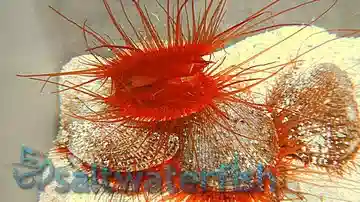
Scallops are non-photosynthetic filter feeders that are generally found on rock reefs and coral reefs. They usually have brightly colored tissue and an oblong hinged shell. If Scallops are well fed and unbothered, they will remain in the same spot, however, if they are under attack, they will use their shells and clap themselves out of harms way. Scallops are peaceful and do well in very clean waters, but require plankton type foods to stay healthy.
Scallops For Sale
Featured Products
Add to Waiting List
Size:
Status: Currently out of stock
Customer Details
Please confirm your name and email address below. We will contact you via email as soon as this product is available.
Scallops In Saltwater Aquariums: FAQ
Live scallops are technically reef safe, but practically unsuitable for most saltwater reef tanks. The issue is not aggression, toxicity, or compatibility; it’s that standard reef systems are fundamentally incompatible with how scallops survive.
Scallops are obligate filter feeders that evolved to live in environments with a constant supply of microscopic plankton. Modern reef aquariums are designed for the opposite goal: clear water, low nutrients, and aggressive filtration. Even healthy, mature reef tanks usually cannot maintain the continuous food density scallops require, which leads to slow starvation rather than sudden failure.
This is why scallops often appear healthy for weeks or months before declining. Their difficulty is delayed, not immediate, which makes them one of the most misunderstood invertebrates in the hobby.
Live scallops are only appropriate in highly specialized systems, such as non-photosynthetic (NPS) aquariums or tanks specifically designed for continuous live phytoplankton dosing with reduced mechanical filtration. These setups are uncommon and require advanced experience.
One Saltwaterfish.com reviewer of the Flame Scallop shared: “This is a nice scallop. Nice cream color shell with bright red hair like things as pictured.”
Bottom line: live scallops are not recommended for typical reef tanks. While peaceful and beautiful, they require purpose-built systems to survive long term. Most reef keepers are better served admiring scallops as advanced specialty animals rather than standard reef inhabitants.
Scallops eat only microscopic suspended foods, which is the single most important fact to understand before attempting one in captivity. They do not eat algae, detritus, pellets, frozen foods, or leftover fish food, even indirectly.
Their diet consists almost entirely of live phytoplankton and naturally occurring micro-particulates suspended in the water column. This food must be present continuously, not delivered in short feeding windows. Spot feeding does not work for scallops because they feed passively by filtering water, not by grabbing food.
In very mature systems, scallops may also consume bacteria, dissolved organic matter, and natural plankton populations, but these sources are rarely sufficient on their own in modern reef aquariums.
Most reef tanks unintentionally starve scallops because:
Protein skimmers remove plankton rapidly
Mechanical filtration strips suspended food
- Low-nutrient reef goals limit plankton production
One Saltwaterfish.com reviewer of the Flame Scallop shared: “The flame scallop I got was feisty from the get go. As soon as I got it out of the bag, it squirt water at me\! That's love at first sight:) It has moved around a bit, but for the most part it hosts my heater. At first, I thought it got stuck with the hoses and the heater. I moved it out a few times, it always finds its way back to the same spot. I have not done any direct feeding. But I dose phytoplankton every other day. I heard those things have short lifespan, but hopefully between that all all the other goodies, it will stay alive for awhile.”
Bottom line: scallops eat live phytoplankton and microscopic suspended foods only. Because most reef tanks are not designed to maintain these foods continuously, feeding (not water quality) is the primary limitation to long-term success.
Keeping scallops alive in a reef tank is extremely difficult, even for experienced aquarists. They are widely considered one of the hardest commonly sold marine invertebrates to maintain long term, not because they are fragile, but because their survival requirements conflict with standard reef-keeping practices.
The difficulty comes from chronic, invisible starvation. Scallops often look healthy while slowly declining, which creates a false sense of success. By the time symptoms appear (weak shell closure, inactivity, gaping) recovery is rare.
Unlike fish or corals, scallops have very little margin for error. Minor instability in salinity, temperature, or flow can interrupt feeding and accelerate decline. Once stressed, they recover poorly.
This is why success stories almost always involve:
Very mature aquariums
Daily or continuous live phytoplankton dosing
Reduced mechanical filtration
Systems designed specifically for filter feeders
One Saltwaterfish.com reviewer of the Flame Scallop shared: “Flame scallop was very big and healthy. Great buy but he does stir up the sand.”
Bottom line: scallops are extremely hard to keep alive in reef tanks because they require constant nutrition and exceptional stability. For most hobbyists, long-term survival is unlikely without a specialized setup.
In theory, scallops are capable of living several years in captivity. In practice, however, most scallops live only a few weeks to a few months in typical saltwater aquariums. This large gap between potential lifespan and real-world survival is the main reason scallops are considered high-risk, advanced invertebrates in the marine aquarium hobby.
Expected lifespan of scallops in aquariums:
Typical reef tanks: A few weeks to 3–6 months
Well-established, advanced systems: 6–12 months (occasionally longer)
Highly specialized NPS systems: Multiple years (rare and advanced)
The vast majority of losses are caused by chronic starvation, not sudden disease or water quality failure.
Why scallops rarely reach their full lifespan in aquariums:
Insufficient continuous nutrition
Scallops require a constant supply of live phytoplankton and suspended microfoods. Most reef tanks (especially those with aggressive filtration) cannot maintain the food density scallops need around the clock.
Delayed signs of decline
Scallops often appear normal even as they slowly starve. By the time symptoms become obvious (weak shell closure, gaping, inactivity), recovery is unlikely.
Sensitivity to modern reef systems
Reef aquariums are designed to remove nutrients and plankton, which directly conflicts with scallop survival.
When long-term survival is possible:
Scallops may live years only in:
Very mature aquariums
Systems with continuous live phytoplankton dosing
Tanks designed specifically for filter feeders
Carefully managed NPS setups
These systems require advanced experience and ongoing effort.
One Saltwaterfish.com reviewer of the Flame Scallop shared: “Very nice specimen\! Matched the color and quality of the high end local fish store \- for a lot lower cost\! Looks just like the picture.”
Important expectations to set before buying a scallop:
Scallops are not beginner-friendly
Long-term survival is uncommon
Regular feeding alone is often not enough
- Losses can occur despite best efforts
Bottom line:
While scallops can live multiple years under ideal conditions, most survive only weeks to months in standard saltwater aquariums. They should be viewed as advanced, high-maintenance invertebrates that require specialized systems to thrive. For responsibly sourced scallops, honest care guidance, and an 8-Day Live Guarantee, explore the Scallop Collection at Saltwaterfish.com and decide with confidence whether a scallop fits your aquarium’s capabilities.
Scallops require exceptionally stable water parameters to survive in a reef aquarium, and even when parameters are “perfect,” long-term success is still challenging without proper nutrition. Unlike many corals and hardy invertebrates, scallops have very low tolerance for fluctuation, making parameter stability just as important as hitting ideal numbers.
Recommended water parameters for scallops:
Temperature: 74–78°F
Salinity: 1.024–1.026 specific gravity
pH: 8.1–8.4
Alkalinity: 8–9 dKH
Calcium: 400–450 ppm
Magnesium: 1250–1350 ppm
Ammonia & Nitrite: 0 ppm (critical)
Nitrate: As low as possible (ideally \<5–10 ppm)
Phosphate: Very low but detectable (not zero)
Scallops can tolerate reef-level nutrients, but rapid swings (even within acceptable ranges) often lead to stress and decline.
Why stability matters more than “perfect” numbers:
Scallops are highly sensitive to changes in:
Salinity from evaporation or water changes
Temperature fluctuations
Flow redirection
Sudden nutrient shifts
Minor instability that corals tolerate can cause scallops to stop feeding, weaken shell closure, and slowly starve.
Flow requirements (often overlooked):
Scallops need moderate, indirect flow that keeps food suspended in the water column.
Too little flow causes starvation
Too much direct flow prevents feeding and causes stress
The hidden challenge: filtration vs. feeding
Modern reef tanks use skimmers and mechanical filtration that quickly remove plankton. While parameters may look ideal on paper, scallops often starve because the system is too clean.
One Saltwaterfish.com reviewer of the Flame Scallop shared: “Very happy with scallops.”
Pro tips for maintaining scallop-friendly conditions:
Use auto top-off to stabilize salinity
Avoid large, sudden water changes
Maintain consistent flow patterns
Dose live phytoplankton regularly
Monitor behavior: weak shell closure is an early warning sign
Bottom line:
Scallops require stable, reef-level water parameters with minimal fluctuation, but water chemistry alone is not enough for long-term survival. Without consistent plankton availability, even ideal parameters won’t prevent decline. For responsibly sourced scallops, transparent care expectations, and an 8-Day Live Guarantee, explore the Scallop Collection at Saltwaterfish.com and decide confidently whether your system is truly suited for this demanding invertebrate.
The main challenges of keeping scallops are system design conflicts, not husbandry mistakes. Even attentive aquarists often fail with scallops because the tank itself works against them.
The biggest challenge is nutrition. Scallops need nonstop access to microscopic food, but reef tanks are built to remove it. Protein skimmers, filter socks, and mechanical filtration strip plankton faster than scallops can consume it, leading to slow starvation.
The second challenge is stability. Scallops are extremely sensitive to small fluctuations in salinity, temperature, and flow. Changes that corals tolerate easily can cause scallops to stop feeding.
The third challenge is recovery. Once a scallop begins to decline, intervention rarely succeeds. This delayed failure is why losses often feel sudden and unavoidable.
Scallops are best attempted only by aquarists with:
Advanced experience
Mature systems
Continuous live phytoplankton dosing
Tanks designed for non-photosynthetic filter feeders
Bottom line: the main challenges of keeping scallops are meeting constant feeding demands, maintaining extreme stability, and overcoming filtration conflicts. These challenges make scallops unsuitable for most reef tanks despite their beauty and peaceful nature.
Feeding scallops is not a task, it is a system-wide commitment. Scallops cannot be target fed, spot fed, or supplemented occasionally. They survive only when microscopic food is present in the water column continuously.
Live phytoplankton is mandatory. It must be dosed daily or continuously at sufficient density using small-cell phytoplankton suitable for bivalves. Powdered or dead substitutes alone are rarely effective long term.
Scallops also consume bacteria and dissolved organic particles, which are present only in very mature systems. Unfortunately, most reef tanks are engineered to remove these particles as quickly as possible.
Because scallops feed passively:
Pipettes and turkey basters do not work
Short feeding windows are ineffective
- Flow must keep food suspended without blasting the animal
Successful feeding often requires reducing mechanical filtration and accepting higher nutrient levels than SPS-focused reefs tolerate.
Bottom line: feeding scallops requires continuous live phytoplankton availability and system-level support. Even with proper feeding, scallops remain one of the most difficult invertebrates to sustain long term.
While scallops themselves do not require large amounts of physical swimming space, the ideal tank size for keeping scallops is driven by system stability and food availability, not the scallop’s shell size. In practice, scallops perform best in larger, mature aquariums, where water parameters fluctuate less and continuous plankton feeding is more realistic to maintain.
Recommended tank size for scallops:
Minimum practical size: 75 gallons
Preferred size: 100–150+ gallons
Best long-term success: Large, mature systems or dedicated non-photosynthetic (NPS) aquariums
Smaller tanks can technically house scallops, but they rarely provide the nutritional density and stability required for survival beyond a short period.
Why larger tanks are better for scallops:
Greater parameter stability
Scallops are extremely sensitive to changes in salinity, temperature, and flow. Larger water volumes buffer against rapid swings caused by evaporation, feeding, or maintenance.
Improved feeding consistency
Scallops need a continuous supply of live phytoplankton and suspended microfoods. In larger systems:
Food remains suspended longer
Feeding density is easier to maintain
Plankton production is more consistent
Reduced impact of filtration conflicts
In small tanks, protein skimmers and mechanical filters strip plankton almost instantly. Larger systems allow for better balance between filtration and feeding, though this remains challenging even at scale.
Flow control is easier
Scallops require moderate, indirect flow to feed properly. Larger tanks allow more nuanced flow patterns without blasting the animal or starving it.
Important clarification:
A large tank does not guarantee success. Even in 150+ gallon systems, scallops often fail without dedicated feeding strategies. Tank size simply improves the odds.
Pro tips when choosing a tank for scallops:
Only attempt scallops in very mature systems (6–12+ months)
Be prepared for daily or continuous phytoplankton dosing
Avoid ultra-low-nutrient reef setups
Monitor shell closure and feeding response closely
Bottom line:
The ideal tank size for scallops is 100 gallons or larger, not because scallops need space, but because they need stability and constant access to planktonic food. Smaller tanks dramatically reduce survival odds. For responsibly sourced scallops, transparent care expectations, and an 8-Day Live Guarantee, explore the Scallop Collection at Saltwaterfish.com and make an informed decision based on your system’s true capabilities.
Yes, scallops can move in a saltwater aquarium, but their movement is limited, occasional, and often misunderstood. Unlike snails or clams that slowly crawl, scallops are capable of short bursts of movement by rapidly clapping their shells together to propel themselves through the water. This behavior is fascinating to observe, but it does not mean scallops actively roam the tank or relocate frequently.
How scallops move in aquariums:
Jet-propelled “clapping” motion
Scallops move by forcefully opening and closing their shells, expelling water to create thrust.
Movement is usually brief and sporadic
Often triggered by stress, handling, or sudden changes in flow
Not a daily or constant behavior
In most aquariums, scallops spend the majority of their time stationary, resting on rockwork or the substrate.
Limited repositioning, not roaming
Scallops do not crawl or deliberately explore like mobile invertebrates. If a scallop relocates, it is usually because:
Flow is too strong or too weak
Lighting or placement is uncomfortable
The animal is stressed
Frequent movement is often a warning sign, not normal behavior.
Why scallop movement matters to care:
Moving scallops can knock into corals or rockwork
Repeated clapping consumes energy and increases nutritional demand
Excessive movement may indicate poor placement or declining health
Healthy scallops generally remain open, responsive, and stable in one location.
Placement tips to reduce unnecessary movement:
Provide moderate, indirect flow
Avoid direct powerhead blasts
Place on stable rock or flat surfaces
Maintain consistent parameters
Minimize handling after placement
Bottom line:
Scallops can move, but they are not active or roaming invertebrates. Occasional movement is normal, but frequent or frantic motion usually signals stress. In properly placed, stable systems with adequate feeding, scallops remain mostly stationary. For responsibly sourced scallops and transparent care expectations backed by Saltwaterfish.com’s 8-Day Live Guarantee, explore the Scallop Collection and add this unique (but demandin) invertebrate with confidence.
Choosing fish to live with pet scallops requires a very conservative, compatibility-first approach. While scallops are peaceful and reef safe, they are extremely sensitive, slow-feeding filter feeders that can be stressed or starved by the wrong tank mates. The best companions are fish that are non-aggressive, non-predatory, and unlikely to interfere with feeding or stability.
Best fish choices to keep with scallops:
Small, peaceful reef fish
These species tend to ignore scallops and do not harass or disturb them:
Clownfish (non-aggressive species)
Firefish
Cardinalfish
Small gobies (watchman, neon, clown gobies)
These fish have gentle feeding behaviors and minimal impact on water movement around scallops.
Planktivores (with caution)
Fish that feed in the water column can coexist only if scallops receive sufficient plankton:
Anthias
Chromis
These species increase competition for planktonic food, so they require heavy and consistent phytoplankton dosing to avoid starving the scallop.
Fish to avoid with scallops:
Wrasses (may pick at mantles)
Triggerfish, puffers, hogfish
Large angelfish
Butterflyfish
Any aggressive or inquisitive species
These fish may nip at scallops, knock them over, or outcompete them for food.
Why tank mates matter so much:
Scallops do not defend themselves, move slowly, and rely on constant access to suspended microfoods. Stress from tank mates or reduced food availability often leads to slow, unnoticed starvation.
Pro tips for mixing fish with scallops:
Choose calm, reef-safe fish only
Avoid overcrowding
Maintain moderate, indirect flow
Dose live phytoplankton consistently
Observe scallops daily for shell closure strength
Bottom line:
Only small, peaceful reef fish should be kept with pet scallops, and even then, success depends on excellent stability and continuous plankton feeding. Aggressive, curious, or fast-feeding fish dramatically reduce survival odds. For responsibly sourced scallops and transparent care expectations backed by Saltwaterfish.com’s 8-Day Live Guarantee, explore the Scallop Collection and plan your livestock carefully with confidence.